SUPPORT ETHIOPIA INSIGHT
Ethiopia needs stronger safeguards against the politics of demographic dominance.
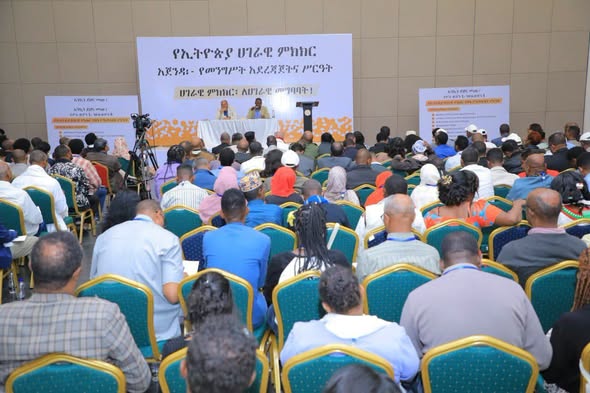
In July 2026, as the Ethiopian National Dialogue Commission works through its eight thematic pillars, a memorandum submitted by the author of this article for consideration by the commission raises a question the dialogue cannot afford to avoid: How can Ethiopia remain united without allowing one group to dominate the others?
The answer begins with taking minority protection seriously. Ethiopia’s deepest problem is not ethnic federalism itself, but the failure to make it work fairly. Constitutional safeguards are needed, including protections for smaller groups, equal representation in federal institutions, meaningful representation for communities living outside their home regions, and an independent institution dedicated to minority rights.
These should not be misconstrued as demands that undermine unity. They are demands for a federation in which minorities can trust that their rights will survive a change in political power.
For decades, Ethiopian state-building rested on what can be described as mono-ethnic narratives, leaving little room for the histories and identities of other peoples. That has often meant treating the expansion of the imperial state as a shared national achievement while overlooking how communities incorporated through conquest experienced it. For those communities, Menelik II’s conquests are not distant history but part of their political memory today.
That history cannot simply be wished away. Reconciliation that avoids it risks becoming another exercise in political convenience.
One place to begin is the national flag. Ethiopia needs a symbol that can be claimed equally by its Muslim and Christian citizens and its many ethnic communities.
This does not necessarily require changing the current flag. It does require resisting any return to the imperial-era tricolor flag, which many minorities associate with Orthodox Christian nationalism and monarchical rule. For communities that remember religious and political exclusion, even a symbolic rollback can carry a powerful message.
The same problem appears in the design of federal institutions. Smaller regions need a constitutional veto mechanism to prevent them from simply being overridden by a federal majority. The House of Federation should also give states genuinely equal representation rather than allowing demographic weight to determine political influence.
If one group can outvote everyone else, smaller groups can be overridden whenever their interests conflict with those of the majority. That is why minority protection cannot depend on political goodwill; it must be guaranteed by the constitution.
The argument applies equally to Ethiopians living outside their ancestral regions. Addis Ababa and Dire Dawa are home to large populations whose ethnic identities do not necessarily correspond to the regions in which they live. Yet people can face discrimination in housing, employment, public services and political representation because of that identity.
Meaningful representation of such communities in local government is therefore essential. A federation that protects people only when they are inside their designated ethnic homeland is not enough. Ethiopians move, marry, work and settle across regional boundaries. Their institutions must reflect that reality.
Religious Rights
Religious grievances also need to be addressed. Seemingly ordinary administrative decisions can have a similar effect when public sanitation campaigns, examinations, or meetings are scheduled on major Islamic holidays.
Restrictions affecting mosque construction and Muslim burial practices in Axum also raise questions about whether Muslims are treated as equal citizens.
Addressing these grievances is not an attack on Christianity. It is a matter of applying the constitutional principle that religion and state are separate. Article 11 makes that separation explicit. The problem is that the principle has not always been reflected in administrative practice.
The same applies to property.
Land and property confiscated during political transitions, particularly property belonging to Harari communities that was nationalized or redistributed without due process, cannot simply be treated as a closed chapter.
Restitution is about recovering property, but also about the state acknowledging that an injustice occurred.
Without that acknowledgement, calls for reconciliation can sound empty.
Ethiopia also needs a permanent and independent minority protection institution to receive complaints, monitor violations, and advocate for constitutional rights. Existing human rights institutions play important roles, but protecting minorities requires sustained attention rather than occasional interventions after a crisis has already erupted.
Majoritarian Rule
The National Dialogue already has an ambitious agenda. That is no reason to leave the grievances of smaller communities unresolved, especially when those grievances have repeatedly fueled political conflict.
The commission has an opportunity to address a weakness at the heart of Ethiopia’s federal experiment. The 1995 Constitution promised self-determination to the country’s nations, nationalities and peoples. Yet federal institutions have not always protected smaller groups from the power of larger ones.
The result is an uncomfortable paradox. Ethiopia moved from a system in which political domination was enforced through monarchy and centralization to one in which demographic strength can itself become a source of domination. Federalism was supposed to break with that history by giving the country’s peoples a constitutional basis for governing themselves.
That history matters because Ethiopia did not begin as a single centralized state. Before Menelik II’s expansion, the territory that became modern Ethiopia was home to kingdoms, sultanates, principalities and other political systems with their own institutions and traditions. Harar, Kaffa, the Oromo Gadaa system, the Afar sultanates and the Amhara-Tigrayan principalities had their own forms of political organization and did not operate as parts of a single centralized state.
The imperial expansion of the late 19th century brought many of these territories under a central authority. Menelik II and later Haile Selassie built a highly centralized state that subordinated local institutions and promoted a dominant political and cultural order.
The Derg did not reverse this pattern. Its Marxist-Leninist ideology rejected the old imperial order, but its highly centralized state continued to suppress regional and ethnic political aspirations. The Red Terror and military campaigns in Tigray and Eritrea demonstrated the extent to which the regime was prepared to use force against demands for autonomy.
The 1995 Constitution represented a fundamental break. It recognized Ethiopia’s nations, nationalities and peoples and granted them the right to self-determination, including secession.
For the first time, the country’s diversity was not merely something the state had to tolerate. It became part of the constitutional order.
Yet the promise has not been fully realized.
Federalism has often been implemented from the top down, while political parties and dominant groups have exercised disproportionate control over state institutions. The House of Federation, intended to represent the country’s nations and nationalities, has failed to protect smaller groups from demographic and political dominance.
Stronger minority safeguards would reinforce rather than undermine federalism by making its promise of equal protection more credible.
A Better Federation
The case for multinational federalism is not that Ethiopia should freeze its communities into separate political boxes, nor that historical grievances should become permanent claims against one another. A workable federation must instead give people enough security to participate in a common political system without fearing that political defeat will mean cultural or territorial subordination.
A majority should be able to govern, but it should not be able to use its majority to strip smaller communities of their political protections. Equal state representation, carefully defined minority vetoes, linguistic access to justice and independent oversight are necessary safeguards against that kind of majoritarian rule.
Other multinational democracies have developed similar mechanisms. Switzerland gives its constituent units significant protection despite their different sizes. Canada has built institutional protections around linguistic minorities. Ethiopia does not need to copy either country. The important point is that smaller communities need institutions they can rely on when their interests diverge from those of the majority.
The same principle should shape peacebuilding.
National politics tends to focus on the largest and most powerful actors. Political negotiations revolve around the federal government and major regional forces, while smaller communities appear only when they become caught up in conflict.
A settlement between the strongest factions can end one confrontation while leaving the underlying vulnerabilities of smaller communities untouched. Those grievances then become the raw material for the next crisis.
A peace settlement will remain fragile if smaller communities still fear that the political system cannot protect them. That is the real test of federalism.
Lasting Unity
Ethiopia has tried centralized monarchy, military rule and ethnic federalism. None has produced a political order in which every community feels secure.
Federalism can still work, but only if Ethiopia takes its constitutional promise of minority protection seriously.
Minority vetoes, equal representation, protection for communities outside their home regions, religious equality, property restitution and independent minority-rights oversight all serve one basic purpose: ensuring that unity does not depend on minorities remaining permanently vulnerable to majorities.
Ethiopia does not have to agree on every interpretation of its history before it can build fair institutions. But it does have to acknowledge that different communities remember the state differently, and that those memories shape how they respond to political change today.
The National Dialogue Commission therefore faces a choice. It can treat minority concerns as another collection of demands to be managed, or it can see them as evidence of a deeper institutional problem.
If Ethiopia wants federalism to survive, the second approach is the more serious one.
A state becomes stronger when its minorities do not have to fear the majority. That is the promise Ethiopia made in 1995. The task now is to make that promise real.
Query or correction? Email us


While this commentary contains the author’s opinions, Ethiopia Insight will correct factual errors.
Main photo: Participants in Ethiopia’s national dialogue conference engage in discussions on nation-building in Addis Ababa, 11 August 2026. Source: Ethiopian National Dialogue Commission/Facebook.

Published under Creative Commons Attribution-NonCommercial 4.0 International licence. You may not use the material for commercial purposes.


Leave a Comment