
SUPPORT ETHIOPIA INSIGHT
Former TPLF leader’s journey from defiant revolutionary to loyal ally reflects Ethiopia’s enduring paradox
The “Sof Omer Weg,” an elite forum promoted by state media as Prime Minister Abiy Ahmed’s dialogue with former and current state officials in the famed Sof Omar cave of Bale, Oromia, drew widespread public attention, though not for the reasons intended.
Among the prominent attendees, none attracted more scrutiny than Getachew Reda and Tsadkan Gebretensae, figures who, only a few years ago, stood at the forefront of the Tigrayan resistance that nearly unseated the Prime Minister himself.
Officially billed as a brainstorming session on the region’s development, the gathering revealed far more than policy ambition. It offered a living tableau of Ethiopia’s enduring political dilemmas: selective justice, transactional loyalty, and a culture where survival continues to eclipse conviction.
This dynamic was personified in the contradictory narrative of Getachew. On one hand, he accused former leaders of intending to “plunder” Bale, a serious allegation of planned criminal exploitation.
On the other, he has publicly admitted to committing serious crimes under a previous administration, yet remains a prominent figure in the current government. This stark contradiction highlights a system where political power trumps legal accountability, allowing high-level actors to operate with impunity even after confessing to wrongdoing.
For many Ethiopians, Getachew’s role in this political theater resembles that of a court jester. While he bears the outward appearance of this medieval entertainer, he lacks the role’s historic capacity for truth-telling. He performs to amuse his “king,” but fails to fulfill the jester’s deeper purpose: to speak truth to power disguised as jokes.
Path Back to Power
Getachew, who had once dismissed Abiy’s administration as “illegitimate” and mocked the Prime Minister as a “political dwarf,” now appeared on national television walking hand in hand with the very leadership he had once condemned.
He and his former comrade in arms, Tsadkan, went further, outdoing each other in a contest to offer the most flattering praise of the Prime Minister, a spectacle as startling as it was surreal.
The symbolism was unmistakable: their visit to Bale was not merely a tour of a culturally rich region, it was a path back into the fold of power.
Reflecting on past neglect, Getachew told the crowd:
“Historically, we have made the decision—whether consciously or not—to remain poor… I came to Bale 15 years ago to inaugurate the opening of a new road. At the time, that was the only road in the entire area. I said, how could it be that, at the very least, they failed to see the importance of building a road to utilize the resources in the area? Back then, I used the phrase ‘robbing the area’—but maybe that word was a bit too harsh.”
When criticism followed, he turned to Facebook to clarify: “Whatever I have said publicly reflects my genuine views and beliefs… I would never say anything merely to please anyone.” He added that his remark about “looting” referred to regimes preceding Meles Zenawi’s, insisting that he owed no apology, an apparent bid to appease his Tigrayan supporters.
This clarification, however, only solidifies the original interpretation of his words. By confirming his comments were intentional, his “harsh” self-reflection becomes a profound admission, political, emotional, and almost existential. It reveals a figure who now operates with an awareness of his own impunity.
The once-fiery revolutionary has thus traded the language of resistance for the lexicon of a system insider, a shift that speaks volumes about the transactional nature of power in Ethiopia’s current political landscape.
Principles to Pragmatism
Getachew’s political metamorphosis served as a compelling case study in Ethiopia’s politics of survival, where conviction is negotiable and principle bends under pressure. His journey—from TPLF spokesman and fighter for a people’s cause to government ally—illustrates how political adaptation in Ethiopia can blur the line between resilience and opportunism.
While the question of whether this shift represents an ideological awakening, a strategic compromise, or mere self-preservation remains open, his public record suggests an alignment with political expediency. This evolution reflects a broader trend in Ethiopian politics, where the pursuit of power consistently overshadows moral clarity and accountability.
The tone of accommodation was on full display at the launch of Abiy Ahmed’s book Yemedemer Mengist (“Government of Synergy”). Getachew confessed that he had once read Abiy’s earlier work, Synergy, intending to critique it—only to abandon the effort when he “left for the jungle.”
Regretting his premature judgment, he praised the Prime Minister’s new book as “a profound work” capable of shaping policy and lauded its theoretical rigor.
He even joked about the political typologies in the book, declaring, “I am sure I did not belong to any of the seven categories… but I will definitely not be among the Yetechenekerew (anachronist) group”, a pointed jab at the TPLF’s current leadership. The audience applauded.
Yet beneath the levity, his remarks marked something weightier: the formal end of opposition and the start of alignment.
For a man who, just four years ago in an interview with Tigray Television, labeled Abiy a “political dwarf,” such praise signals more than reconciliation; it amounts to submission to the prevailing narrative. In Ethiopia’s theatre of politics, where public loyalty is currency, Getachew’s realignment secures his place among the survivors, not the dissenters.
Ultimately, in an Ethiopian political landscape where justice is often performative, Getachew’s path risks reinforcing a familiar theme: the system prioritizes loyalty over principle. Should he continue to align with those who value personal advancement above all, he will cement his standing as an emblem of this transactional reality.
Resistance to Realignment
Before the Tigray War erupted in 2020, Getachew was among the TPLF’s most defiant voices. He denounced Abiy Ahmed’s government as authoritarian, rejected the national elections, and framed the confrontation as a fight for Tigray’s survival.
His words were cutting: “Working with Abiy Ahmed is impossible; it requires political idiocy and an anarchic mind.” Through both military mobilization and relentless messaging, Getachew helped craft a narrative of existential struggle, one that inspired many Tigrayans to fight and sacrifice for the cause.
But wars end, and so do absolutes. The men who once led the charge are now the ones cutting deals and opening roads.
When Abiy once invited cooperation under the Prosperity Party framework, Getachew ridiculed him insisting that collaboration was unthinkable. He claimed Abiy survived only by manufacturing conflict and that removing him was a moral duty.
Yet today, that same Abiy stands beside him in Bale, smiling for the cameras. The irony is sharp— the man who once scorned compromise now embodies it.
For many Tigrayans who lost loved ones believing they were fighting for freedom, this reversal feels like betrayal dressed as reconciliation. Their leaders have emerged not as martyrs or visionaries but as actors in a political play, where peace often looks like surrender.
Politics of Forgetting
Abiy reportedly once told Tsadkan that “any person will surrender for either power, money, or prestige.” Tsadkan rejected that notion, but history seems to have proven over, the two leaders of TPLF, the prime minister right. Both Tsadkan and Getachew now orbit the same political center they once condemned.
It is tempting to frame this as reconciliation, a necessary compromise for peace. But it is equally plausible to view it as self-preservation, a familiar instinct in Ethiopian politics where betrayal is less a moral failure than a career move
Getachew Reda’s transformation—from a fiery revolutionary to a cooperative figure within Abiy Ahmed’s Ethiopia—captures the contradictions of a political system that often rewards conformity over conviction. In doing so, he has not only crossed a political aisle but also a moral line, raising fundamental questions about the cost of compromise and the erosion of principle in the pursuit of power.
Throughout both the struggle for freedom and the recent conflict in Tigray, the Tigrayan people endured immense hardship and loss. Their sacrifices were guided by faith in moral principles—justice, integrity, and collective responsibility—and by deep trust in the TPLF’s leadership to safeguard those values.
In the aftermath of the war, however, perceptions of this leadership have grown increasingly divided. Some believe that certain leaders have drifted from the movement’s founding ideals, while others view their actions as pragmatic responses to the region’s complex political realities.
The case of Getachew Reda embodies these intertwined moral and political tensions. His trajectory reflects how the erosion of principle within leadership can transform public trust into disillusionment. For a community that long equated its struggle with moral purpose, such a shift represents not merely political disappointment but a profound ethical rupture.
Ultimately, Tigray’s experience underscores a lasting truth: sustainable peace and genuine reconciliation cannot be achieved through power or pragmatism alone. They must rest on a foundation of moral clarity, accountability, and an unwavering commitment to the values that once united its people.
The new road in Bale will carry trucks and travelers, but it also carries a message: in Ethiopian politics, the line between conviction and convenience is vanishingly thin.
Query or correction? Email us


While this commentary contains the author’s opinions, Ethiopia Insight will correct factual errors.
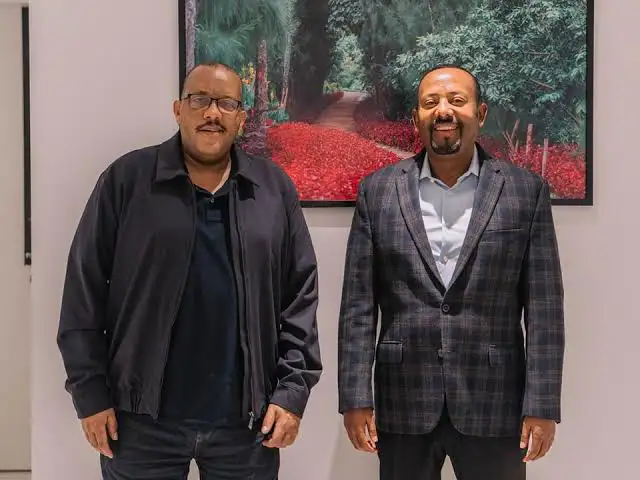
Main photo: Getachew Reda, Advisor on East African Affairs, with Prime Minister Abiy Ahmed. Source: Ethiopia Broadcasting Corporation

Published under Creative Commons Attribution-NonCommercial 4.0 International licence. You may not use the material for commercial purposes.


Different times, different perspectives. Don’t blame the two gentlemen because they refused to put the people of Tigray through the madness of the recent past, another war.
Considering his withering criticism of Abiy’s political opinion in the past, Getachew Reda now in his effusive flattery about medemer is probably more of convenience than conviction. Wars do end, and Getachew has made his peace with Abiy. And so, it seems has Gen. Tsadkan.
Abiy and Amhara extremists waged the war on Tigray to remove TPLF. All along, the political tension between Abiy and TPLF has been visceral and unbridgeable, and at the present time putting Tigray in a limbo with no end in sight. TPLF has defended Tigray when needed. But the time has come for TPLF to dissolve itself for the sake of Tigray people, for a chance of peace and recovery. In which case, Abiy should have no excuse to neglect Tigray, to be vindictive towards its people.
And this is where Getachew and Tsadkan’s new alignment with Abiy can be seen as significant, two prominent Tigray leaders who can lead the transition for peace and hope in Tigray. Whether displaced people in Tigray can return to their homes, or are given relief and settlement where possible is yet to be seen. Once the crime of ethnic cleansing is carried out, it is often irreversible.
Getachew Reda now has the title, Advisor Minister to the PM on Eastern African Affairs, which I think would implicitly include the Horn of Africa matters. This brings up Abiy’s project of ”access to the sea” understood to mean that he wants a port for both civilian maritime and a militarized naval base in the HOA. Eritrea’s port of Assab is now seen as the hot point of tension, and Isaias just spent a week in Cairo, his timing to visit Egypt seems to coincide with the port matter, perhaps the need for security of Assab. Getachew Reda the Advisor can expect to be called upon to give his opinion about this issue in official meetings. One thing to remember, Eritrea is a sovereign nation, a member of the Red Sea Council of coastal states, which means it has friends.
Gatachew Reda, and General Tsedikan Gebiretensay. God protect and and bless You.
YOU are the men of princepl.