SUPPORT ETHIOPIA INSIGHT
Better exam security hasn’t made Ethiopian classrooms more honest or human.
A few months ago, a clip from an Ethiopian game show went viral. A husband whispered the answer to his wife so she could win. When the host replayed the footage and caught him, the man didn’t apologize. He didn’t even look embarrassed. He just kept going.
It’s tempting to laugh this off as a bad moment on light entertainment. But it’s worth asking a harder question: if someone will lie this openly on national television, what happens in the workplace, in business, in public office, in the thousand ordinary moments when no camera is rolling?
That’s not really a question about one man. It’s a question about what our institutions are producing. Family, religion, friends, politics, media: all of these shape character. But school is the one institution nearly every Ethiopian passes through for more than a decade. If we want to understand where certain habits come from, we have to look at what happens, or doesn’t, inside the classroom.
Hidden Lessons
Over the past twenty years, Ethiopia has built schools, enrolled millions more children, and made real progress on access. That’s genuine progress. But it leaves an important question mostly unasked: what kind of people are these classrooms producing?
Education should teach literacy, numeracy, science, technical skill, and it does. But it has always done more than transmit knowledge. It shapes how people treat each other: whether they take responsibility, whether they can be trusted, whether they choose honesty when a shortcut is easier. By that measure, our results look less impressive than the exam statistics suggest.
Every school runs two curricula at once. One is written down, in textbooks, lesson plans, civics classes. The other is never announced, but it’s taught every day, through what gets rewarded and what gets ignored. Researchers call it the hidden curriculum, and children learn it not from what teachers say but from how school actually works.
Students hear plenty about honesty and responsibility in assemblies. Then they learn, from daily experience, that a good score matters more than how you got it, that repeating the approved answer beats asking a real question, and that beating your classmate counts for more than helping them. None of this is written anywhere. It might be the most durable lesson they get, precisely because it repeats every day.
Grading Appearances
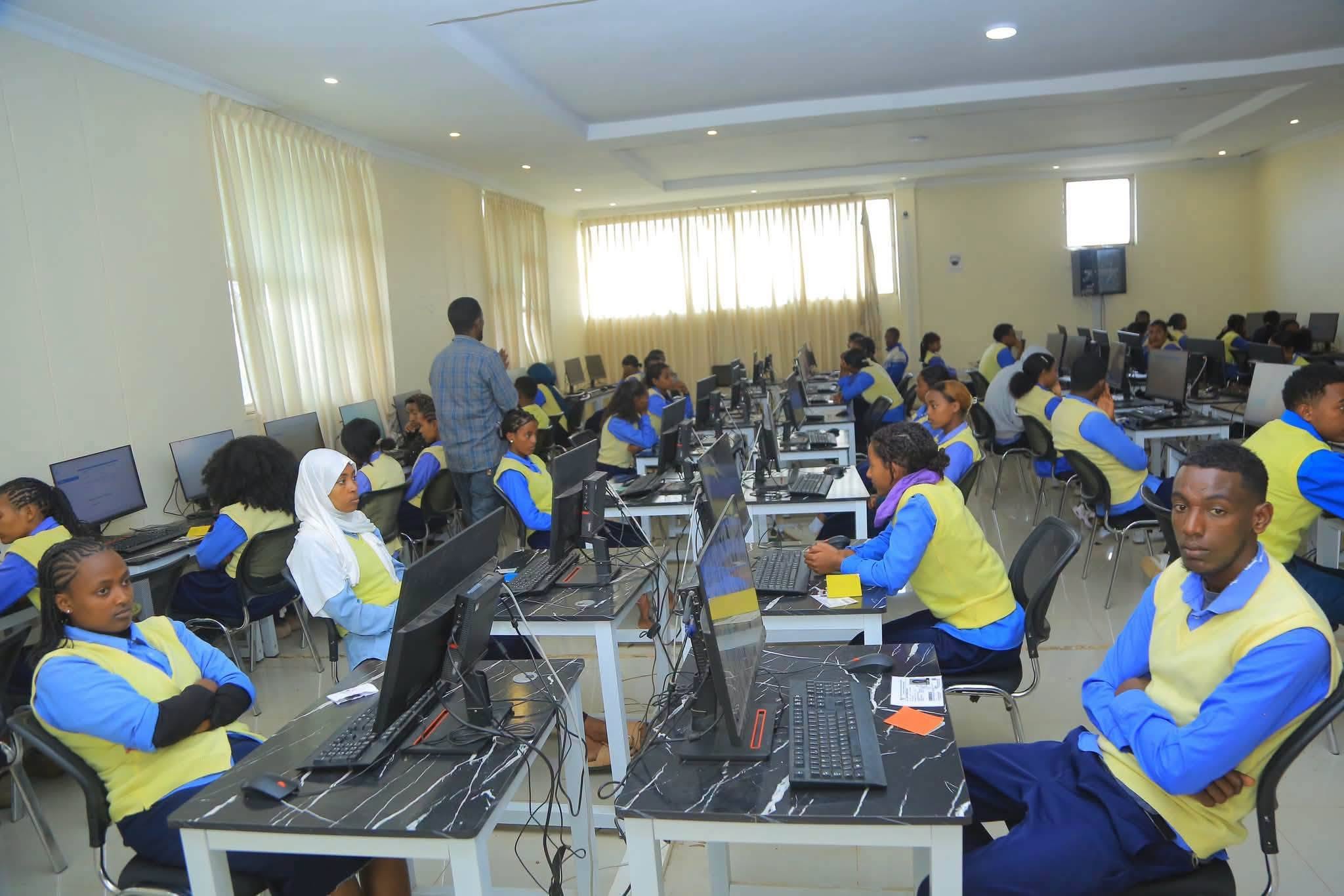
For a decade, cheating haunted Ethiopia’s Grade 12 national exam, the gateway to university. In 2022, the Ministry of Education moved the exam out of secondary schools and into universities, with university staff invigilating. It worked, dramatically: reported cheating cases fell from over 20,000 in 2021–22 to 859 the year after.
Then came the uncomfortable part. Once cheating was gone, more than 96 percent of students failed to reach the 50 percent pass mark. Pass rates were 3.3 percent in 2022, and 3.2 percent in 2023, rising to 8.4 percent in 2025, meaning more than nine in ten students still don’t qualify for university.
The real issue wasn’t the scores. It’s what the system had been rewarding all along. When a single number becomes the whole measure of success, it’s hard to convince anyone that how they got the number matters too.
Universities show a mirror version of the same problem. A growing number of students graduate with near-perfect GPAs, yet employers routinely describe the opposite experience: weak technical skills, poor communication, an inability to apply what was studied. Research on Ethiopian higher education backs this up, showing GPAs climbing without any matching rise in competence. A transcript full of A-pluses stops meaning much once everyone has one, and students absorb the same lesson again: appearance beats substance.
Public Trust
That lesson doesn’t stay in the classroom. It shows up in how people treat what belongs to everyone. Bus seats get slashed because they belong to the state, not to “us.” Streets fill with litter because someone else is expected to clean it. Somewhere along the way, cleverness got confused with self-interest: the person who protects public property looks naive, and the one who exploits it looks smart.
The same pattern shows up in how disagreements get handled. Ethiopia has cycled through political and communal violence more than once, often escalating to force before dialogue is even tried. Schools aren’t responsible for every conflict. Politics, history, and economics all play a part. But if children spend a decade in classrooms where they rarely practice listening to an opposing view or changing their mind in light of better evidence, it shouldn’t surprise anyone when those skills are missing later.
Violence rarely starts with a weapon. It usually starts with an inability to imagine someone else’s point of view. Those habits, empathy and the willingness to seek understanding before victory, have to be built long before a crisis arrives.
Critical thinking runs on the same muscle. Weighing evidence fairly, spotting your own bias, changing your mind when a better argument comes along: none of that is really about raw intelligence. It’s a discipline, built through practice, and classrooms organized around memorization rarely give students the chance to build it.
Empty Classrooms
None of this matters much for the millions of children who can’t get to a classroom at all. In the current Ethiopian year, closing in about a month, schools in Tigray closed early over fears of renewed fighting.
More than 9 million children are out of school across Amhara, Oromia, and Tigray combined, per UN and humanitarian reporting: over 4 million in Amhara alone, and nearly half of all school-age children in Tigray, about 1.2 million.
This gap won’t close on its own. Give it a few more years and it’s not a gap anymore, it’s a generation. When schools are shut, damaged, or repurposed for the military, the message to children is unmistakable: their education is expendable. Whatever they learn when they eventually come back, if they come back, won’t be the curriculum. It will be that safety is fragile and institutions can’t be trusted.
Even open schools struggle. In the newly formed Southern and Central regions, some teachers have gone unpaid, or been paid only partially, since 2023. In Tigray, teachers have waited up to 17 months for back wages, despite court orders. It’s hard to model integrity and hope for students when the state won’t honor its own obligations to the people doing the teaching.
Funding trends make this worse. Education’s share of the national budget has dropped from roughly 16–17 percent a few years ago to about 12 percent in 2024–25, even as schools are asked to deliver more: new curricula, critical thinking, civic education. The result is fewer materials, more crowded classrooms, and a weaker learning environment across the board.
Beyond Exams
Real reform has to go further than rewriting curriculum frameworks. Teachers need training to lead discussion and encourage ethical reasoning, not just deliver content. Grading has to start rewarding honesty and teamwork, not just correct answers, since students notice exactly what gets rewarded. And students need real responsibility, not just lessons about it: solving problems in their own communities, reflecting on consequences, learning that shared spaces only work if everyone maintains them.
None of it is possible if schools stay closed, teachers stay unpaid, and budgets keep shrinking. Reopening schools and paying teachers on time isn’t a side issue to education reform. It is education reform, in its most basic form. A country that leaves millions of children without classrooms can’t credibly claim to be building a society based on trust.
The point of education was never just to produce workers or exam-passers. It’s to prepare people to live with other people. A country can produce excellent engineers and lawyers and still grow poorer if trust and honesty keep eroding underneath them.
The new school year opens in September. Getting the millions of out-of-school children back into classrooms is urgent, and it’s already late. But reopening the buildings isn’t enough on its own. What happens inside them, whether they teach character alongside content, will decide what kind of citizens they produce.
Query or correction? Email us


While this commentary contains the author’s opinions, Ethiopia Insight will correct factual errors.
Main photo: Grade 12 students taking the internet-based national examination, July 3, 2026. Source: Ethiopian Ministry of Education/Facebook.

Published under Creative Commons Attribution-NonCommercial 4.0 International licence. You may not use the material for commercial purposes.


Leave a Comment